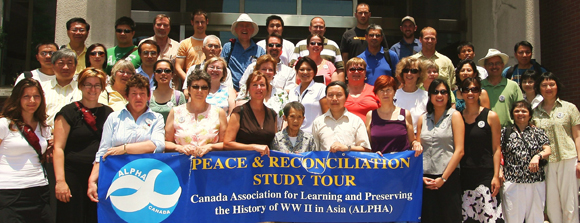
|
|
|
2008 - 2011 Study Tours -- Participant Testimonials
|
Lynne Burns - Teacher (2011 Study Tour)
It is very difficult to identify one particular experience from the 2011 study tour that had the greatest impact on me personally. The whole trip was quite simply the most valuable educational experience of my life and it has been life-altering in ways that I'm still coming to terms with many months after it ended!
As a history teacher, the testimonials by witnesses and experts we heard were absolutely essential as primary sources to provide irrefutable evidence of the truly barbaric atrocities committed by Imperial Japan in the name of ultranationalism before and during World War II in Southeast Asia.
As someone familiar with the European Holocaust, it was an eye-opening experience to realize that similar, if not even more horrific, extreme right-wing ideological policies had been implemented with many of the same justifications as the Nazis had used, namely racism, elitism and militarism. That these policies were carried out deliberately and systematically on such a wide scale over several decades made them even more chilling.
I have arrived at the conclusion that man's inhumanity towards his fellow man has known no bounds, and that the call for today's Japan to acknowledge and atone is now even more paramount.
|
Rosie Kruhlak - Teacher (2011 Study Tour)
The sites visited and the academic enrichment on the China Study Tour of 2011 enhanced my understanding of historical events and reaffirmed my commitment to achieving social justice for the victims of the Asian Holocaust.
Being my first trip to Asia the study tour was an eye-opener to the marvels of ancient Chinese civilization and also to the current impressive economic advancement unfolding in China.
The sites toured, such as Unit 731, the John Rabe Museum and the Jingling Women's University had an especially profound effect on me. It was as if the ghosts of those wronged inhabited the premises still. I was struck by just how ordinary looking some of the buildings were where the atrocities occurred. As I stood in the courtyard of the John Rabe Musuem I envisioned hordes of Japanese soldiers clamouring over the walls that were really not that high, and I understood how vulnerable the refugees were, and what a remarkable feat John Rabe and others performed in saving the thousands that they had.
The testimony of the survivors was hard to bear at times. Close to 75 years later, the pain is raw and undiminished. Paying tribute to the victims at the Nanking Memorial, I pledged that as an educator and fellow human being,
I will forever remember those silenced so long ago.
|
Brendan Edwards - Teacher (2011 Study Tour)
Attempting to put into words an experience as life-changing as this study tour was, can appear,
at least to those who did not share in the same experience, as cliché.
During times of conflict, we've all heard tales of personal terror and transgression and of the unimaginable violence and victimization. Yet for me, prior to this trip, many of these stories were just that, stories. Stories blending together, often indistinguishable one from the next.
What this experience did, however, was to take these once faceless accounts and attach to them something I was not prepared for: personal pain. Every person and every testimony from every survivor brought forward an emotion that was anything but cliché. I had heard of similar stories, but I had not heard of their pain.
|
Rob Pirie - Teacher (2011 Study Tour)
Good professional development impacts your teaching practices and your students. ALPHA's study tours provide the best professional development a teacher could ask for. The impact of hearing the stories of the survivors from the Nanking massacre or the Japanese rape stations is something that has changed what I share with my students forever. Additionally, the stories of survival have had a profound impact on my life.
ALPHA's 2011 study tour was first class in organization, accommodation, meals and professional development. It was an opportunity of a lifetime of which I am so grateful to have been part. I wish all Alberta teachers could take advantage of this opportunity.
|
Dominic Cheng - volunteer ( 2008 and 2009 Study Tours )
Before I went on the Study Tour in 2008, a few people warned me about the emotional drain and
potentially strong reactions in what I would encounter during the tour. Maybe because of the warning,
I did not feel any emotion when I visited the Nanking Massacre Memorial Hall and the Unit 731 Crime Evidence Exhibition Hall.
It was as if I put on an iron shield around my heart to block out any feeling.
Yet the testimonials of teachers during debriefing sessions could easily put me in tears.
There is a House of Sharing near Seoul in South Korea. It was built as a sanctuary for the Korean Comfort Women
to live out their remaining years. Within the compound there is a small interpretive centre to chronicle the history and
distribution of comfort women drafted in Southeast Asia. Adjacent to the interpretive centre is a replica of a so called
comfort station. In 2009, while re-visiting the House of Sharing, I wandered off from our group and went into this replica of comfort station.
It was a tiny cell of no more than 5 ft. by 10 ft; maybe even smaller. There was a small long bench inside.
I lied down on the bench . . . imagining how a comfort woman might have felt in being forcibly used by 30 Japanese soldiers
or more on a daily basis. The stench of semen overflowing and soldiers' sweat was unbearable and she had no way to
ever clean up herself. I felt ashamed. Not because of her sufferings but my seemingly lack of anger while lying there.
Since then I recognize that I had become numb. I apparently resigned to "learned helplessness" - an observed behavior
of dogs being subjected to constant electrical shock but have no way to escape from their cages. But why?
Iris Chang called the continual denials of Asian Holocaust by the Japanese government a Second Rape.
We know that rape perpetrators usually hold their victims in contempt. Iris reminded us that the Japanese government
is holding 29 millions of Chinese people and countless other victims in Korea and Southeast Asia who perished during
the Second World War in contempt by denying its atrocities. It is holding peace makers who want peace and
reconciliation in Southeast Asia in contempt. Most of all, the Japanese government is putting its own citizens in
perpetual Silent Shame when it refuses to acknowledge the historical truth. That constant denial,
that injustice is a constant assault inflicted on so many!
Thankfully ALPHA's Truth and Reconciliation Study Tours have provided participants with an educational experience
that is more than just personally challenging. It has provided many of us with a new voice-a voice heard by others in
growing numbers.
What kind of person would I be and what sort of world would I be handing to future generations if I remained silent,
idly stood by and allowed this Second Rape to continue?
|
Cam Fahlman - Teacher (2008 Study Tour)
Perhaps most valuable was the opportunity I was given to meet with those individuals in China and Korea
who are advocating, on behalf of the survivors, for a sincere apology from the Japanese government.
The efforts and passion of these brave and caring persons has been inspiring.
To me, both the survivors and their advocates are role models: they are today's heroes.
|
Patricia Magliocco - Educator (2008 Study Tour)
Being a participant on the 2008 ALPHA Peace and Reconciliation Study Tour changed my life. It opened up my thinking globally and my heart compassionately. Through what I experienced, I have developed a more acute awareness that we are all on the human journey, and that as global citizens we are called to service to help bring about a world of peace and justice.
We are One.
|
|
|